

Medicare GUIDE Model Explained (2026): Dementia Support and Caregiver Respite
Caring for someone with dementia isn’t a side job.
It’s a full-body, full-heart responsibility—often unpaid, often invisible, and always exhausting.
I lost my father to dementia in 2010. I know firsthand how disorienting and lonely this journey can be—especially when you’re trying to understand what help actually exists.
That’s exactly why the Centers for Medicare & Medicaid Services (CMS) created the Medicare GUIDE Model—a nationwide pilot designed to support both the person with dementia and the family member holding everything together.
And yes—as of 2026, it’s still very much alive.
Let’s walk through this without the bureaucratic fog.

If you want the plain-English foundation first, start here: Medicare coverage basics.

What the Medicare GUIDE Model Actually Is
GUIDE stands for Guiding an Improved Dementia Experience—and for once, the name isn’t lying.
It’s a CMS Innovation Center pilot program testing whether coordinated, team-based dementia care can:
- Improve quality of life for people living with dementia
- Reduce stress and burnout for unpaid caregivers
The program officially launched on July 1, 2024, and is designed to run for about eight years, which means it remains active well into 2026.
One important truth, right up front:
GUIDE services are only provided through health care organizations approved by CMS.
This is not something you enroll in through an insurance agent or a Medicare Advantage plan.
For readers who want the official details, CMS maintains an overview of the GUIDE Model on its website.

What Services the GUIDE Model Includes
This model doesn’t pretend dementia affects only one person. It supports the whole ecosystem.
Depending on the participating organization, services may include:
- A dedicated dementia care team and care navigation
- Personalized care plans
- 24/7 access to support for urgent questions
- Caregiver education and hands-on training
- Connections to local, community-based resources
- Respite services for some eligible participants
The goal is simple but powerful:
Help people with dementia stay safely at home or in their community as long as possible—without breaking the caregiver in the process.
If you need broader support beyond GUIDE, here are my dementia caregiving resources.

About Respite and Adult Day Care
Yes, respite is included—but with boundaries. Healthy ones.
Under the GUIDE Model, CMS allows up to $2,500 per year in respite services for eligible beneficiaries.
Respite may be provided:
- In the person’s home
- Through an adult day center (medical or social)
- In a facility that offers 24-hour care
Here’s the part people miss:
- In-home respite must be offered
- Adult day center respite is optional and depends on what each GUIDE organization provides
- GUIDE respite services do not require Medicare cost-sharing
And let’s be crystal clear:
This does not mean Medicare broadly covers adult day care.
Adult day services are available only:
- Within the GUIDE Model
- For eligible individuals
- Through participating providers
Who Can Qualify for GUIDE Services?
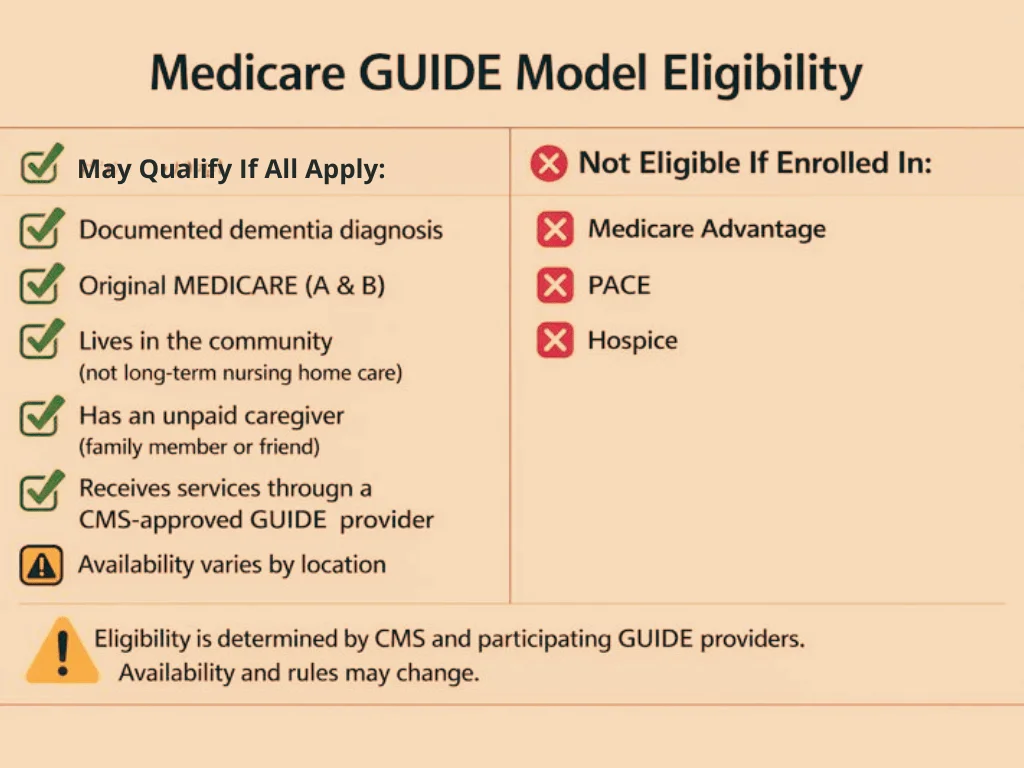
Eligibility is determined by CMS rules and the participating GUIDE organization. Generally, the person must:
- Have a documented dementia diagnosis
- Be enrolled in Original Medicare (Parts A & B)
- Not be enrolled in Medicare Advantage, PACE, or hospice
- Live in the community (not long-term nursing home care)
- Have an unpaid caregiver (a family member or friend)
- Receive services through a CMS-approved GUIDE provider
Availability and exact services vary by location. Geography matters here.
Is the GUIDE Model Available in Florida?
Yes—but not everywhere.
Parts of Florida participate through CMS-approved health care organizations. Availability varies by county and provider, and some communities still don’t have a participating GUIDE organization.
In Florida communities where GUIDE is active, services may include:
- Care coordination
- Caregiver education
- 24/7 support
- Limited respite services
In some counties, respite may include adult day programs—if local GUIDE providers offer them.
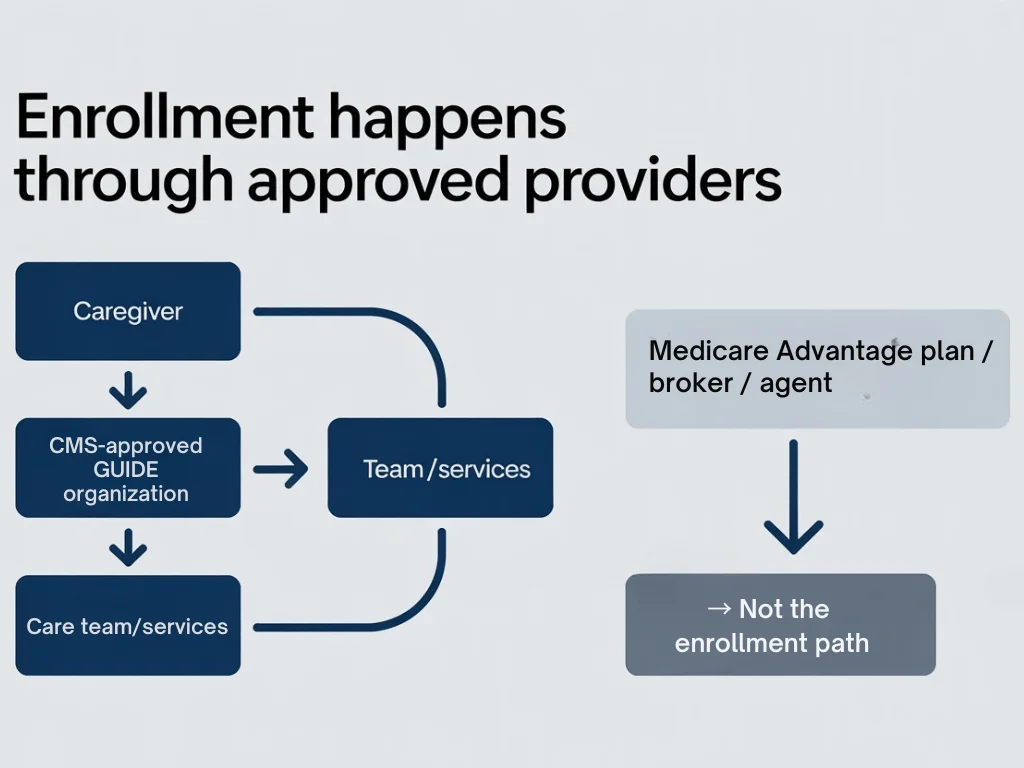
GUIDE is a pilot, not standard Medicare coverage. Enrollment happens through approved providers—not Medicare Advantage plans, not brokers, not insurance sales calls.
This information is especially relevant for caregivers in:
- Manatee County
- Sarasota County
- Hillsborough County
- Polk County
- Hardee County
- DeSoto County
Does Medicare Normally Cover Dementia Care?
Medicare does provide coverage for certain medical services related to dementia, but many families are surprised to learn that the program does not cover every aspect of long-term care.
Understanding the difference between medical treatment and custodial care is key to understanding what Medicare will — and will not — pay for.
Medicare Covers Diagnosis and Medical Treatment
Under Medicare Part B, the program generally covers medical evaluation, diagnosis, and treatment for dementia-related conditions.
This may include:
- doctor visits
- cognitive assessments
- brain imaging such as MRI or CT scans
- certain laboratory tests used to identify the cause of memory or cognitive changes
If you’re wondering how Medicare handles dementia evaluations specifically, you can read a more detailed explanation here:
➡ Does Medicare Cover Dementia Testing? Cognitive Screening, Brain Scans & Memory Exams Explained
This guide explains how cognitive testing works, what diagnostic services Medicare may cover, and how doctors evaluate possible dementia.
Medicare Does Not Cover Long-Term Custodial Care
While Medicare covers medical treatment, it generally does not pay for long-term custodial care.
Custodial care refers to ongoing assistance with activities of daily living such as:
- bathing
- dressing
- eating
- supervision for safety
These services are typically provided in memory care facilities, assisted living communities, or long-term nursing homes, and are usually paid for privately, through long-term care insurance, or through Medicaid if someone qualifies.
How the GUIDE Model Helps Support Dementia Caregivers
Because dementia care often requires long-term support, the Centers for Medicare & Medicaid Services (CMS) created the GUIDE Model (Guiding an Improved Dementia Experience).
The program was designed to help address gaps in dementia care by offering care coordination and caregiver support services through participating health care organizations.
The GUIDE Model focuses on:
- limited respite support for caregivers
- care coordination for dementia patients
- caregiver education and training
- care planning and navigation
Is the GUIDE Model Still Active in 2026?
Yes.
As of 2026, the Medicare GUIDE Model remains active and under evaluation by CMS.
The program launched on July 1, 2024 and is expected to run for multiple years while CMS studies whether coordinated dementia care can improve patient outcomes and reduce caregiver burnout.
Because it is a pilot program, CMS may adjust participation rules, providers, or availability over time as the model is evaluated.
Important Note About the GUIDE Model
- GUIDE is a limited CMS pilot program, not a standard Medicare benefit
- Eligibility, availability, and respite options vary by provider and location
- Enrollment happens through CMS-approved GUIDE organizations, not through insurance plans or agents
Frequently Asked Questions (FAQ)
Families researching dementia care often have questions about how the GUIDE program works. Below are answers to some of the most common questions.
What is the Medicare GUIDE Model?
The Medicare GUIDE Model (Guiding an Improved Dementia Experience) is a pilot program created by Centers for Medicare & Medicaid Services (CMS) to test whether coordinated, team-based dementia care can improve quality of life for people living with dementia and reduce burnout for unpaid caregivers.
It is not a standard Medicare benefit and is offered only through participating, CMS-approved health care organizations.
Is the Medicare GUIDE Model still active in 2026?
Yes. As of 2026, the Medicare GUIDE Model remains active and under evaluation by CMS. The model launched on July 1, 2024, and is designed to run for multiple years while CMS studies outcomes and effectiveness.
Who is eligible for GUIDE services?
Eligibility is determined by CMS rules and the participating GUIDE organization. In general, a person must:
- Have a documented dementia diagnosis
- Be enrolled in Original Medicare (Parts A & B)
- Live in the community (not long-term nursing home care)
- Have an unpaid caregiver (family member or friend)
- Receive services through a CMS-approved GUIDE provider
Eligibility and available services may vary by location and provider.
Is GUIDE available in Florida?
Yes—but not everywhere.
Parts of Florida participate through CMS-approved GUIDE organizations, but availability varies by county and provider. Some Florida communities currently have no participating GUIDE organization.
Does GUIDE cover adult day care?
Not broadly.
Adult day care is not a standard Medicare benefit. Under the GUIDE Model, adult day services may be available only as part of GUIDE respite services, only for eligible participants, and only if a local GUIDE provider offers them.
How much respite does GUIDE allow per year?
For eligible beneficiaries, the GUIDE Model allows up to $2,500 per year in respite services.
Respite may be provided in the home, through adult day centers (if offered by the provider), or in certain care facilities, depending on the participating organization.
Does GUIDE require Medicare cost-sharing?
No. GUIDE respite services do not require Medicare cost-sharing for eligible participants. Other aspects of care are handled under the GUIDE Model’s structure through participating providers.
Can someone on Medicare Advantage enroll in GUIDE?
Generally, no.
Individuals enrolled in Medicare Advantage, PACE, or hospice are not eligible for GUIDE services while enrolled in those programs. GUIDE is designed for people in Original Medicare (Parts A & B).
How do I find a CMS-approved GUIDE provider?
Enrollment in the GUIDE Model happens through CMS-approved GUIDE organizations, not through Medicare Advantage plans, brokers, or insurance agents.
The best starting point is to search CMS resources or contact local health systems and organizations that provide dementia care to ask whether they participate in the GUIDE Model.

The Takeaway for Caregivers
The Medicare GUIDE Model is one of the most meaningful attempts CMS has made to support dementia care—and the caregivers quietly carrying it.
It may include respite.
Sometimes that respite looks like adult day care.
But it is not universal, not automatic, and not traditional Medicare coverage.
If you’re a caregiver, this program isn’t a miracle—but it can be a lifeline when you know exactly what it is and what it isn’t.