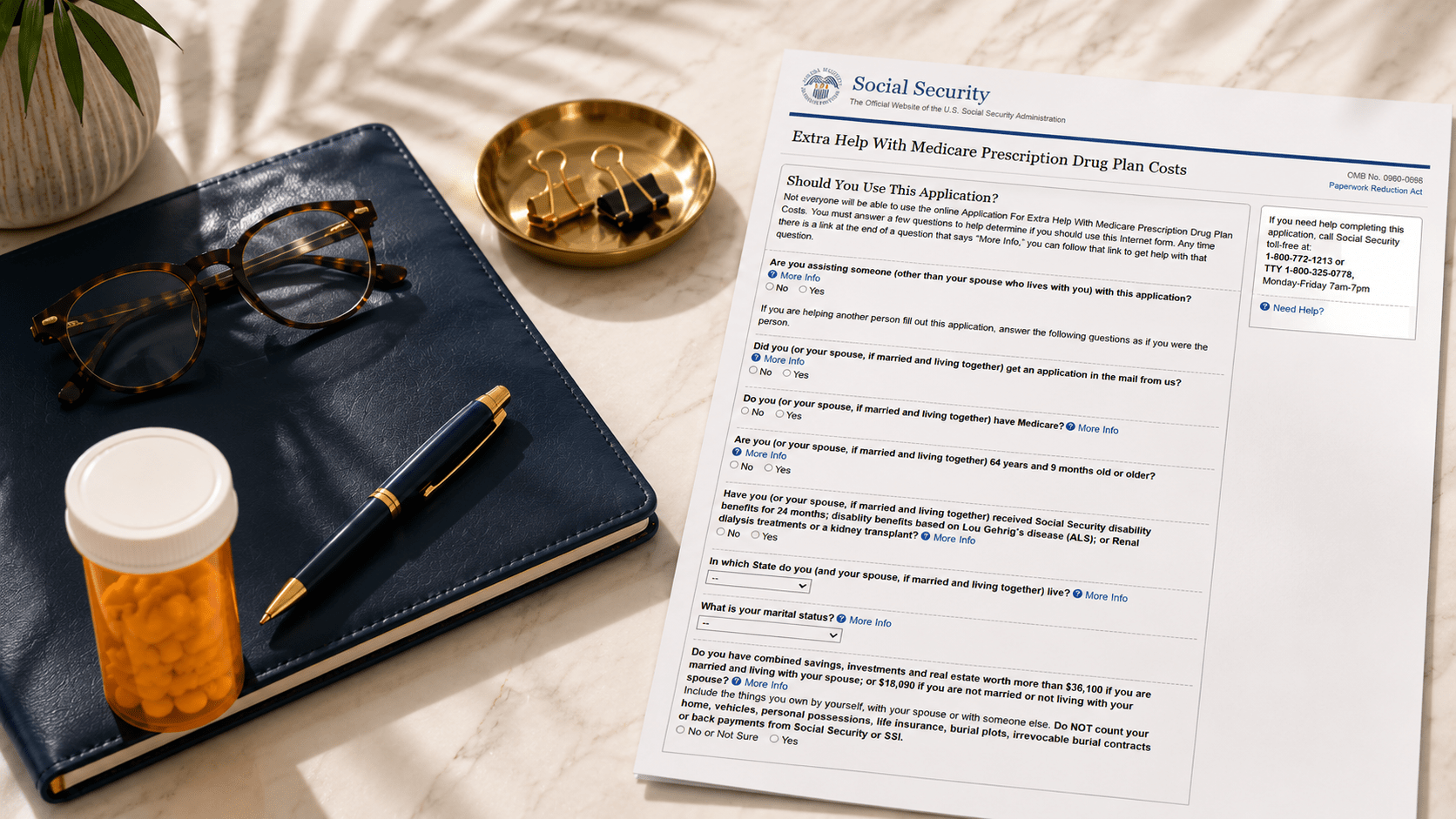
Medicare Part D Extra Help Program: Who Qualifies and How to Apply
Plain-English guidance on 2026 income limits, eligibility, copays, and what this program actually means for your drug costs.
The Medicare Part D Extra Help Program pays most or all of your prescription drug costs if your income and resources fall below certain limits. In 2026, a single person can qualify with an annual income up to $23,940 and resources up to $18,090. If you qualify, you pay $0 deductible, $0 or very low plan premium, and as little as $5.10 per generic drug — with nothing more once your drug costs reach $2,100 for the year.
Prescription drug costs are one of the biggest financial stresses people face on Medicare. I hear it all the time: “I didn’t realize I’d be paying this much for my medications.” What a lot of people don’t realize is that there’s a federal program specifically designed to fix that — and millions of people who qualify for it haven’t applied.
It’s called Medicare Part D Extra Help. Some people know it as the Low Income Subsidy (LIS). Whatever you call it, it can cut your drug costs by hundreds or even thousands of dollars a year.
Here’s what you need to know about it in 2026 — including the income limits, what it actually pays for, who gets it automatically, and how to apply if you don’t already have it.
Key Takeaways
- Extra Help is a federal program that dramatically reduces your Part D prescription drug costs if you qualify.
- In 2026, the income limit is $23,940 for a single person and $32,460 for a married couple.
- The resource (asset) limit is $18,090 for one person and $36,100 for a couple — and many things you own don’t count.
- There’s no partial Extra Help anymore — since 2024, everyone who qualifies gets the full subsidy.
- If you have Medicaid, SSI, or a Medicare Savings Program, you already qualify automatically — no application needed.
- You apply through Social Security, not Medicare, and it’s free to apply.
- What Is the Medicare Part D Extra Help Program?
- Who Qualifies for Extra Help?
- 2026 Income and Resource Limits
- How Much Does Extra Help Pay?
- Who Gets It Automatically?
- Extra Help in Florida: What’s Different
- How to Apply for Medicare Part D Extra Help
- Renewals and Annual Reviews
- Frequently Asked Questions
- Final Thoughts
What Is the Medicare Part D Extra Help Program?
Medicare Part D Extra Help — officially called the Low Income Subsidy (LIS) — is a federal assistance program run jointly by the Social Security Administration (SSA) and the Centers for Medicare & Medicaid Services (CMS). Its job is simple: help people with limited income and resources afford their prescription drugs.
If you qualify, Extra Help picks up most of what you’d otherwise owe on a Part D drug plan — premium, deductible, and copays. Depending on your medications and plan, the savings can be significant.
Extra Help works alongside your Part D plan. You still need to be enrolled in a Medicare drug plan (either a standalone Part D plan or a Medicare Advantage plan with drug coverage). Extra Help just dramatically lowers how much you owe.
Before 2024, there was a partial Extra Help tier that covered less depending on your income. That’s gone now. The Inflation Reduction Act eliminated partial Extra Help. Today, if you qualify at all, you receive the full subsidy. It’s one benefit level — the maximum — or nothing.
Who Qualifies for Extra Help?
To qualify for Extra Help, you need to meet two tests: an income test and a resource test. Both must be satisfied.
Income
Your annual income needs to fall at or below 150% of the federal poverty level. For 2026, that works out to $23,940 for a single person or $32,460 for a married couple living together.
One thing worth knowing: income counting for Extra Help is more forgiving than it looks at first glance. Several things that might feel like income don’t actually count toward your limit — including SNAP benefits, housing assistance, home energy assistance, help from family members paying your household expenses, and certain tax credits.
Resources (Assets)
Resources are what you own — your savings, investments, and other financial assets. The 2026 resource limit is $18,090 for a single person and $36,100 for a married couple (using the standard burial expense exclusion).
Many things people assume count actually don’t, including:
- Your primary home
- Your car (any vehicle)
- Personal belongings and household items
- Life insurance policies
- Burial expenses (up to $1,500 per person)
What does count: checking and savings accounts, CDs, stocks, bonds, IRAs, mutual funds, and non-home real estate. If you have savings over the limit, it’s still worth running through the full calculation — the exclusions make a real difference for a lot of people.
2026 Income and Resource Limits
| What’s Being Measured | Single Person | Married Couple |
|---|---|---|
| Annual income limit | $23,940 | $32,460 |
| Resource limit (with burial exclusion) | $18,090 | $36,100 |
| Resource limit (without burial exclusion) | $16,590 | $33,100 |
These are the standard limits for the 48 contiguous states and Washington D.C. Alaska and Hawaii have higher income limits because the federal poverty guidelines are higher there — but the resource limits are the same nationwide.
You may see slightly different figures in older SSA publications. SSA’s printed consumer booklet still shows 2025 limits in some versions. For 2026, the current authoritative sources are Medicare.gov and the SSA Program Operations Manual (POMS). Those are the numbers used in this article.
How Much Does Extra Help Pay?
In 2026, full Extra Help means:
| Cost Category | With Extra Help |
|---|---|
| Plan premium | $0 (for benchmark-eligible plans) |
| Deductible | $0 |
| Generic drug copay | Up to $5.10 |
| Brand-name drug copay | Up to $12.65 |
| After total drug costs reach $2,100 | $0 for all covered drugs |
| Late enrollment penalty | Waived while you have Extra Help |
The Premium Fine Print
The “$0 premium” headline is accurate for most plans — but not every plan. Extra Help pays toward the premium up to the regional low-income premium benchmark set by CMS each year. In 2026, Florida’s benchmark is just $4.82 per month. That’s actually very low compared to states like New York ($58.82) or New Jersey ($54.17).
The practical effect in Florida: there are Part D plans available with $0 premiums, and Extra Help will cover your costs there in full. But if you voluntarily choose a higher-priced plan, Extra Help only covers up to the benchmark — you’d owe the difference. Plan choice still matters.
Special Rule for Full Medicaid and QMB
For most people with full Extra Help in 2026, copays are up to $5.10 for generics and $12.65 for brand-name drugs. Some people with full Medicaid and lower income may pay less, including up to $1.60 for generics and $4.90 for brand-name drugs. If you’re institutionalized or receiving qualifying home- and community-based services, you may pay $0.
“I have Extra Help” doesn’t always mean the same thing for everyone. Your specific situation determines your exact copay tier.
What the Savings Actually Look Like
Using a straightforward example — 12 generic and 12 brand-name fills per year on a typical Part D plan — here’s what the numbers look like:
| Scenario | Annual Cost Without Extra Help | Annual Cost With Extra Help | Estimated Savings |
|---|---|---|---|
| Single person (direct Extra Help applicant) | $1,016.25 | $213.00 | $803.25 |
| Married couple (both on Medicare) | $2,032.50 | $426.00 | $1,606.50 |
| SSI / full Medicaid (lower copay tier) | $1,016.25 | $78.00 | $938.25 |
These are illustrative examples only — not personalized quotes or actuarial averages. Assumptions: 12 generic and 12 brand-name fills per year; annual negotiated drug cost of $2,220; $615 deductible plus 25% coinsurance on the remainder without Extra Help; 2026 copay caps ($5.10 generic / $12.65 brand for most Extra Help enrollees; $1.60 / $4.90 for SSI/full Medicaid at or below 100% FPL) with Extra Help. Beneficiary is assumed to be in a $0-premium benchmark-eligible plan. Actual savings will vary based on your specific plan, drug list, pharmacy, and whether you reach the $2,100 out-of-pocket threshold during the year.
Who Gets Extra Help Automatically?
Some people qualify for Extra Help without ever filling out a separate application — they’re automatically enrolled because of another program they’re already in. This is called “deemed” eligibility.
You’re automatically enrolled in Extra Help if you have any of the following:
- Full Medicaid coverage
- Supplemental Security Income (SSI)
- A Medicare Savings Program that pays Part B premiums — meaning QMB, SLMB, or QI
QDWI — Qualified Disabled and Working Individuals — is a Medicare Savings Program, but it does not automatically qualify you for Extra Help. If QDWI is your only program, you’d still need to apply for Extra Help separately through SSA.
If you’re automatically eligible and not already enrolled in a Part D plan, Medicare will generally auto-enroll you in one. You’re also allowed to switch plans once a month if you want something different — that’s more flexibility than most Medicare beneficiaries have.
Extra Help in Florida: What’s Different
The federal rules are the same in Florida as anywhere else in the continental U.S. But Florida has some nuances worth knowing, especially if you’re trying to figure out the fastest path to getting help.
Florida’s Medicaid Income Rules Are Tighter Than Extra Help
Here’s something that trips people up: you can qualify for Extra Help through SSA even if you don’t qualify for full Florida Medicaid. Florida’s community Medicaid program for older adults (MEDS-AD) has much stricter income limits — around $1,182/month for a single person versus Extra Help’s $1,995/month. Many Floridians are turned down for Medicaid but would easily qualify for Extra Help directly through SSA.
The point: don’t assume a Medicaid denial means Extra Help is off the table too.
Medicare Savings Programs in Florida
Florida’s Medicare Savings Programs (QMB, SLMB, QI) each trigger automatic Extra Help. The 2026 monthly income limits for those programs are:
| Program | Monthly Income (Single) | Monthly Income (Couple) | What It Covers |
|---|---|---|---|
| QMB | $1,350 | $1,824 | Part A & B premiums + Medicare cost-sharing |
| SLMB | $1,616 | $2,184 | Part B premium only |
| QI | $1,816 | $2,455 | Part B premium only |
All three programs share a $9,950/$14,910 resource limit. If you’re in any of these, you automatically have Extra Help too — no separate application to SSA required.
Florida SHINE (Serving Health Insurance Needs of Elders) is the state’s free Medicare counseling program. If you want unbiased help navigating any of this — Medicaid, MSPs, Extra Help — they’re a great resource. Reach them at 1-800-963-5337. There’s no charge, and they won’t try to sell you anything.
How to Apply for Medicare Part D Extra Help
You apply for Extra Help through Social Security — not Medicare, and not your state. SSA handles the application and makes the eligibility determination.
Three Ways to Apply
Online: The fastest route for most people. Go to ssa.gov/medicare/part-d-extra-help.
By phone: Call SSA at 1-800-772-1213 (TTY: 1-800-325-0778). Available Monday through Friday, 8 a.m. to 7 p.m. in your local time zone.
In person: Visit your local SSA field office. In the Tampa Bay area, that includes offices in Bradenton, Sarasota, and Tampa.
What to Gather Before You Apply
Having this information ready will make the process much smoother:
- Bank and investment account statements
- IRA or 401(k) balances
- Pension, Veterans’ benefit, or Railroad Retirement statements
- Information about annuities or other income sources
- Social Security number
- Medicare card
The MSP Connection
When you apply for Extra Help through SSA, you can also let SSA forward your information to Florida DCF to screen you for a Medicare Savings Program at the same time. That’s usually the smart move — if you qualify for QMB, SLMB, or QI, you’ll get Extra Help automatically going forward, and you may also get help with your Part B premium.
If you’d rather not have that information shared, you can opt out during the application.
If You Disagree With the Decision
If SSA denies your application and you think they got it wrong, you can appeal using Form SSA-1021. You generally have 60 days from the date on your notice. The form can be completed online or submitted as a PDF.
Renewals and Annual Reviews
Extra Help is reviewed every year. SSA typically sends review notices in late August. If you receive one (it’s the SSA-1026 form), you have 30 days to return it. If you don’t respond, Extra Help will stop the following January.
One reassuring thing: even if your income changes mid-year, you keep Extra Help for the rest of the calendar year. Changes don’t take effect until January 1.
Your plan will also send you a letter each fall explaining how much help you’ll receive toward your premiums, deductibles, and copays in the coming year — so you’ll have time to compare plans during Open Enrollment if needed.
Frequently Asked Questions
It’s a federal assistance program that helps people with limited income and resources pay for their Part D prescription drug costs. If you qualify, it covers your deductible, reduces or eliminates your plan premium (for benchmark-eligible plans), and caps your drug copays at $5.10 for generics and $12.65 for brand-name drugs in 2026.
$23,940 per year for a single person, or $32,460 for a married couple living together. These are 150% of the 2026 federal poverty guidelines. Some income types — like SNAP benefits, housing assistance, and help from family members paying your household expenses — don’t count toward these limits.
$18,090 for a single person, or $36,100 for a married couple (using the burial expense exclusion). Important exclusions: your home, your vehicle, personal belongings, life insurance, and burial expenses generally don’t count as resources.
Yes. Extra Help applies to any Medicare drug plan — including the Part D component of a Medicare Advantage plan (MA-PD). You don’t have to be in a standalone Part D plan to benefit.
It can. Extra Help covers your plan premium up to the regional benchmark amount — $4.82/month in Florida for 2026. Many Part D plans in Florida have $0 premiums, which means Extra Help eliminates your premium entirely. If you choose a plan priced above the benchmark, you’d owe the difference.
Extra Help is reviewed annually, usually in late August. If SSA sends you a review form (SSA-1026), you have 30 days to return it. If your situation hasn’t changed and you don’t receive a review form, you typically just continue receiving the benefit.
No. The partial Extra Help tier was eliminated by the Inflation Reduction Act, effective January 1, 2024. Starting with 2024 benefit years, anyone who qualifies for Extra Help receives the full subsidy. There’s no reduced-benefit tier anymore.
Yes, in two ways. First, it caps your copays at $5.10 or $12.65 per fill — even for costly brand-name drugs. Second, once your total covered drug costs reach $2,100 for the year, you pay $0 for the rest of the calendar year. For people on high-cost medications, that $2,100 threshold is often reached relatively early in the year.
Final Thoughts
Extra Help is one of the most underused programs in Medicare — not because people don’t need it, but because they don’t know it exists or assume they won’t qualify. If your income and resources fall within the limits, this is worth applying for. The downside of applying is zero. The downside of not applying could be hundreds or thousands of dollars a year in avoidable drug costs.
If you’re already on SSI, full Medicaid, QMB, SLMB, or QI — you already have it. Check your current plan to make sure it’s reflected properly, especially if you recently gained eligibility through one of those programs.
And if you’re not sure whether you qualify, or you just want someone to walk through the numbers with you, that’s exactly what I’m here for. No pressure, no call center — just a straight answer.
Not Sure If You Qualify?
I help Florida Medicare beneficiaries figure this out all the time. If you want a second set of eyes on your situation, I’m happy to take a look — no obligation, no sales pitch.
Reach Out to Robin
Robin Dall
Florida Medicare Broker & Educator
Robin Dall is a Florida Licensed Life, Health & Annuity Agent and founder of RobinsWisdom. This article was researched, written, and reviewed by Robin and reflects Medicare rules and guidance available at the time of publication.
About Robin Dall →- Special Needs Plans in Florida: What Dual-Eligible Medicare Beneficiaries Should Know
- How Medicare Part D Works: Premiums, Deductibles, and the Coverage Gap
- What Is a Medicare Advantage Plan? (And Is It Right for You?)
- Medicare Enrollment Periods: When You Can Sign Up and When You Can’t
- GLP-1 Drugs and Medicare: What’s Covered in 2026
Not connected with or endorsed by the U.S. government or the federal Medicare program. Plan availability varies by location. For personalized guidance, visit robinswisdom.com.
Free Medicare Handbooks
Start here with the one that fits your situation.