Medicare Education
How to Apply for Medicare in Florida
A Step-by-Step Guide to Enrollment
Key Takeaways
- Most people apply through Social Security — not Medicare directly.
- You have a 7-month Initial Enrollment Period. Missing it can lead to late enrollment penalties or delayed coverage.
- Florida does not have a separate state Medicare application. Enrollment in Original Medicare is handled through Social Security.
- If you’re already receiving Social Security benefits, you may be enrolled automatically.
- Still working at 65? You may be able to delay without penalty — but you need to know the rules before you decide.
- Applying for Medicare is not the same as choosing a Medicare plan. There’s a second decision coming.
Who Needs to Apply for Medicare?
Most people need to actively apply for Medicare. If you’re turning 65 and not yet receiving Social Security benefits, you won’t be enrolled automatically — you have to take action. Understanding how to apply for Medicare in Florida starts with knowing which category you fall into.
People who typically need to apply:
- Adults turning 65 who haven’t started Social Security yet
- Some people qualify for Medicare before 65 due to disability, ALS, or ESRD — enrollment rules differ for those situations, so this article focuses mainly on people turning 65 in Florida
- Anyone who delayed Medicare while covered by employer insurance
Who Is Automatically Enrolled?
Some people are enrolled in Medicare Parts A and B automatically and don’t need to apply at all.
You’ll likely be enrolled automatically if:
- You’re already receiving Social Security retirement or disability benefits when you turn 65
- You’re receiving Railroad Retirement Board benefits
- You’ve been on Social Security Disability Insurance (SSDI) for 24 months
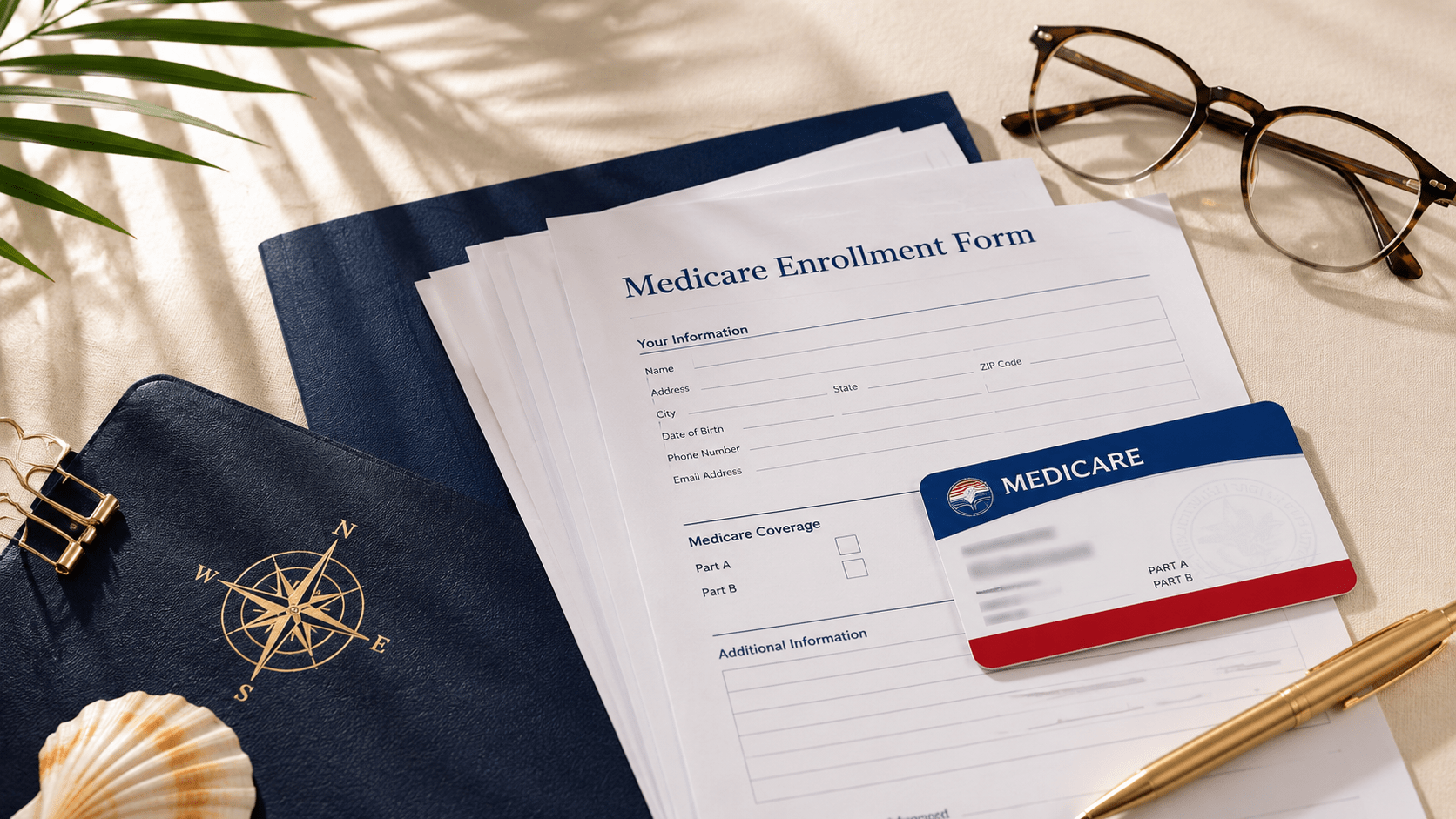
If you fall into one of those categories, your red, white, and blue Medicare card will arrive in the mail about three months before your Medicare coverage starts. No application needed.
If you’re not sure whether you qualify for automatic enrollment, check with Social Security directly or reach out to an independent Medicare broker who can look at your specific situation.
When to Apply: Your Initial Enrollment Period
Your Initial Enrollment Period (IEP) is the seven-month window when you first become eligible for Medicare. It runs:
Your 7-Month Window
- 3 months before your 65th birthday month
- Your birthday month
- 3 months after your birthday month
When you enroll within that window affects when your coverage starts. Enrolling in the first three months generally means coverage starts on the first day of your birthday month. Enrolling during or after your birthday month delays the start date.
If you don’t enroll during your IEP and you don’t have a qualifying reason to delay, you may face late enrollment penalties and a gap in coverage. Depending on the situation, late enrollment penalties can last for many years and in some cases as long as you have Medicare coverage.
How to Apply for Medicare in Florida
Florida does not have a separate state Medicare application. Medicare is a federal program, and enrollment in Original Medicare is handled through Social Security.
You have three ways to apply:
Online
Visit ssa.gov and complete the application in about 10 minutes. You can usually apply online during your Medicare enrollment window — for most people turning 65, that window begins three months before the month they turn 65. This is the fastest and most convenient option for most people.
By Phone
Call Social Security at 1-800-772-1213 (TTY: 1-800-325-0778). Representatives are available Monday through Friday, 8 a.m. to 7 p.m. Wait times can be long, so calling early in the morning or later in the week usually helps.
In Person
Visit your local Social Security office. In the Tampa Bay area, offices are located in Bradenton, Sarasota, and Tampa. Appointments aren’t always required, but scheduling one in advance saves time. Find your nearest office at ssa.gov/locator.
Before you apply, have these ready:
- Your Social Security number
- Proof of age (birth certificate or passport)
- Employment history for the past two years (if still working)
- Information about any current health coverage
What You’re Applying For: Part A and Part B
When you apply for Medicare, you’re applying for Original Medicare — which has two parts:
Medicare Part A — Hospital Insurance
Covers inpatient hospital stays, skilled nursing facility care, hospice, and some home health services. Most people pay no premium for Part A if they or their spouse worked and paid Medicare taxes for at least 10 years (40 quarters).
Medicare Part B — Medical Insurance
Covers doctor visits, outpatient care, preventive services, and medical equipment. Part B has a monthly premium. In 2026, the standard Part B premium is $202.90 per month, although higher-income beneficiaries may pay more through IRMAA (Income-Related Monthly Adjustment Amount).
Original Medicare does not include prescription drug coverage or a cap on out-of-pocket costs. Those decisions come next — after you’ve applied.
Still Working at 65? Read This Before You Apply
If you or your spouse is still working at 65 and covered by an employer group health plan, you may be able to delay Medicare without facing any late penalties. But this is one of the most common areas where people make costly mistakes.
A few things that matter here:
- In most cases, active employer coverage from an employer with 20 or more employees allows you to delay Part B without a late enrollment penalty.
- COBRA and retiree coverage do not count as qualifying employer coverage for this purpose.
- A Health Savings Account (HSA) paired with your employer plan creates its own timing rules once you enroll in Part A.
Before you decide to delay Medicare, it’s worth talking through your specific situation with someone who can look at the details. The rules aren’t complicated once you understand them, but the consequences of getting it wrong can be expensive and permanent.
What Happens After You Apply
Once you’ve applied, Social Security will process your application and Medicare will mail your red, white, and blue Medicare card. Keep it in a safe place — you’ll need the number on that card when you visit doctors and fill prescriptions.
You can also create a MyMedicare.gov account to track your claims and coverage details online.
Getting the card in the mail feels like an ending. It isn’t. It’s the beginning of the next set of decisions.
Applying Is Not the Same as Choosing a Medicare Plan
This is the part most people don’t expect.
When you apply for Medicare, you’re enrolling in Original Medicare — Parts A and B. That’s the foundation. But it leaves real gaps, and you’ll need to make a separate set of decisions:
- Part D — prescription drug coverage. Without it, you may face a late penalty if you go without creditable drug coverage for 63 or more days.
- Medicare Supplement (Medigap) — fills the cost gaps in Original Medicare, like deductibles and coinsurance. Standardized plans, so the coverage is the same from one company to the next — only the price varies.
- Medicare Advantage (Part C) — an alternative to Original Medicare that bundles Parts A, B, and usually D into a single private plan. Often $0 premium, but comes with networks and prior authorization requirements.
None of these decisions happen automatically. Before choosing between Medigap and Medicare Advantage, it helps to understand the major Medicare plan options available in Florida. If you also qualify for Medicaid, how to get Medicaid in Florida if you’re on Medicare is another layer worth understanding before you choose a plan.
That’s step two — and it’s where working with an independent Medicare broker can help you compare your options more clearly.
What If You Missed Your Enrollment Window?
If you missed your Initial Enrollment Period and do not qualify for a Special Enrollment Period, you can generally enroll during the General Enrollment Period, which runs January 1 through March 31 each year. Your coverage usually starts the month after you sign up.
If you’re losing employer or other qualifying coverage, you may qualify for a Special Enrollment Period — which lets you enroll without waiting and often without penalty.
The specifics depend on your situation. If you think you may have missed a window, it’s worth getting a clear answer before assuming you’re out of options.
Frequently Asked Questions
Can I apply for Medicare online in Florida?
Yes. The easiest way to apply for Medicare in Florida is online at ssa.gov — the application takes about 10 minutes. There’s no separate Florida application; it’s all handled federally through Social Security.
What documents do I need to apply for Medicare?
You’ll generally need your Social Security number, proof of age (birth certificate or passport), and information about any current health coverage. If you’re still working, have your employment history for the past two years on hand.
Do I need to apply for Medicare if I’m still working?
Not necessarily — but it depends on your employer’s size and the type of coverage you have. If your employer has 20 or more employees and offers qualifying group coverage, you may be able to delay Part B without a penalty. Talk to someone who can look at your specific situation before you decide.
What if I miss my Medicare enrollment window?
You may still have options. If you’re losing qualifying coverage, a Special Enrollment Period may apply. Otherwise, the General Enrollment Period runs January 1–March 31 each year, and coverage usually starts the month after you sign up. Late penalties may apply depending on how long you’ve gone without coverage.
Is there a Florida Medicare office I can visit?
There’s no Florida-specific Medicare office. Medicare is a federal program. To apply in person, visit your local Social Security Administration office. In the Tampa Bay area, offices are available in Bradenton, Sarasota, and Tampa. Find locations at ssa.gov/locator.
When does my Medicare coverage start after I apply?
It depends on when you apply within your enrollment window. If you apply in the three months before your birthday month, coverage generally starts on the first day of your birthday month. Applying during or after your birthday month delays the start. Social Security can confirm your exact start date when you apply.
Final Thoughts
Applying for Medicare is more manageable than most people expect — especially once you know where to go and what window you’re working with. The timing matters, but it’s not complicated when you have a clear picture of your situation.
Where things get more nuanced is what comes after. Choosing the right drug coverage, deciding between Medigap and Medicare Advantage, and making sure your doctors are covered — those decisions deserve more than a quick internet search or a call-center recommendation built on someone else’s script.
If you want to talk through your specific situation — whether you’re just getting started or you’ve already applied and aren’t sure what comes next — I’m here for that conversation.
Ready to talk through your Medicare options?
No call centers. No 1-800 numbers. Just Robin — an independent Medicare broker serving Florida residents across Manatee, Hillsborough, and Sarasota counties, and virtually throughout Florida, Texas, and Arizona.
Request Your Free Medicare Review
Robin Dall
Florida Medicare Broker & Educator
Licensed Since 2013 • NPN 17032552
Robin Dall is a Florida Licensed Life, Health & Annuity Agent and founder of RobinsWisdom. This article was researched, written, and reviewed by Robin and reflects Medicare rules and guidance available at the time of publication.
About Robin Dall →Read More
Not connected with or endorsed by the U.S. government or the federal Medicare program. Plan availability varies by location.
Free Medicare Handbooks
Start here with the one that fits your situation.